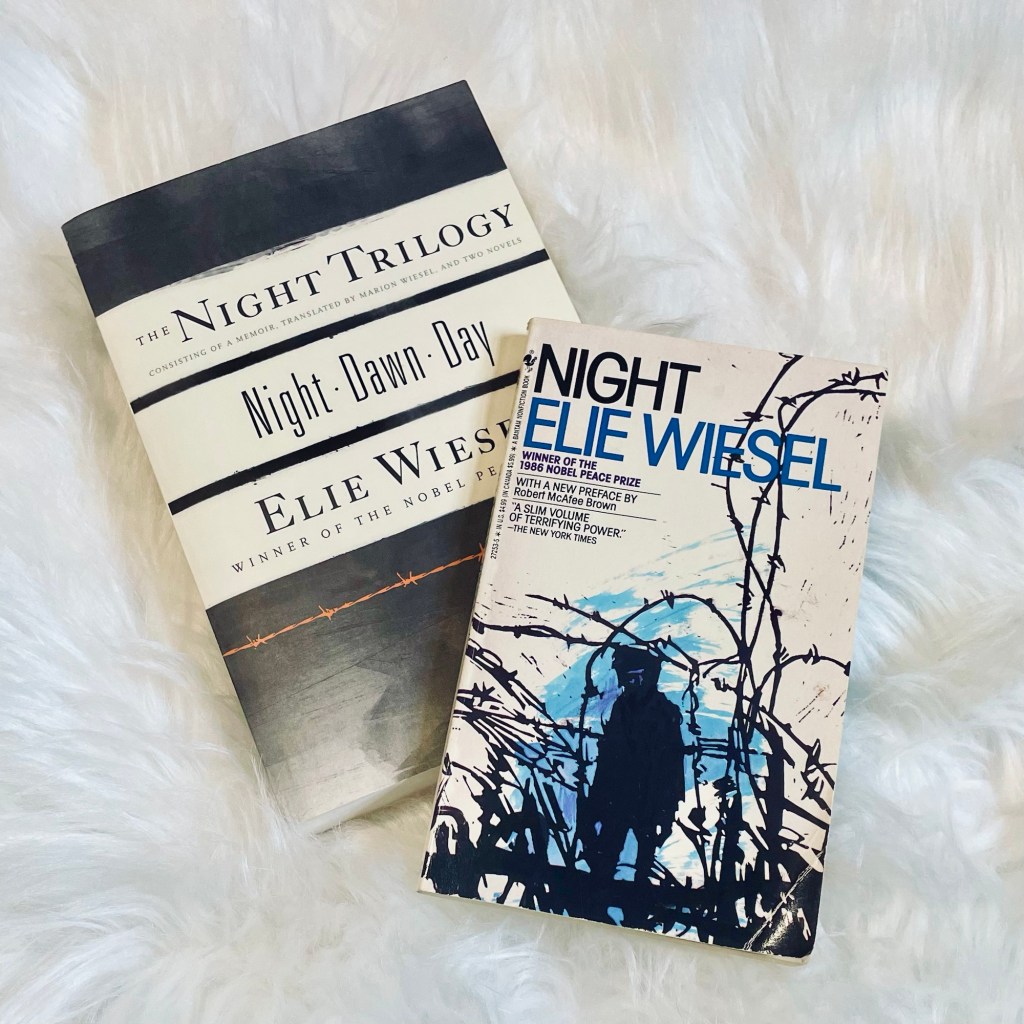
Night by Elie Wiesel
A Five-Star Book Review
My dad handed me Night by Elie Wiesel when I was 13 or 14 years old, and I’m not being hyperbolic in saying that the book changed my life. I opened my eyes to the horrors of the world when reading Mr. Wiesel’s account of his time in the Auschwitz and Buchenwald concentration camps. I’ve read it several times since then, and now that my daughter is reading it in her sophomore English class, I decided to listen to the audiobook.
The Importance of Night
It’s difficult to say that I enjoy reading Night, but I firmly believe that it is an important book, one that everyone should read. This relatively short (120 pages) memoir is brutal in its subject matter, but necessary in its messages. It’s a book that is simple in its words and stark in its descriptions. For me, it is like a beautiful black and white photo, with clean lines from afar but filled with nuanced shadows up close.
As I listened to Night this October, one of the most striking parts of Mr. Wiesel’s memoir was his description of Moishe the Beadle, the poor outsider who teaches young Elie about Jewish mysticism. The Gestapo deported Moishe from Sighet, Elie’s town, but the man returned with terrible stories of what Hitler’s forces were doing to Jews and other groups. Yet, no one believed Moishe’s warnings. They didn’t think the Nazis would reach Sighet.
As I listened to the narrator, I kept urging young Elie to change his mind, to convince his father and family to run. Yes, I’ve read Night multiple times, but this still gets me. I wonder if Elie and the people of Sighet questioned Moishe because they could not believe that such horrors of humanity were possible?
And then, as Mr. Wiesel walks the reader through his time in the concentration camps, it is clear: yes, such cruelty does exist. There is a scene in that Elie witnesses that haunts me (a simple reader) to this day. I have to wonder, how could anyone go on after experiencing such evil?
But, Night answers that with Mr. Wiesel’s wisdom. He tells us that death will haunt him (Elie) forever, despite being liberated from Buchenwald. If this were a fictionalized story, perhaps the main character may have seen a light of hope or focused on the future. Mr. Wiesel is honest that he will never leave that death behind. And why would he?
Final Thoughts about Night
Today, 12 November 2024, in a time when the world feels more divided than I’ve ever known, Night feels appropriate. This memoir is a brutal account of what hatred and war and oppression do to people. Books help us understand personal experiences and how to take action to make a difference. Reading is political, friends.
 Bookish Brain
Leave a comment