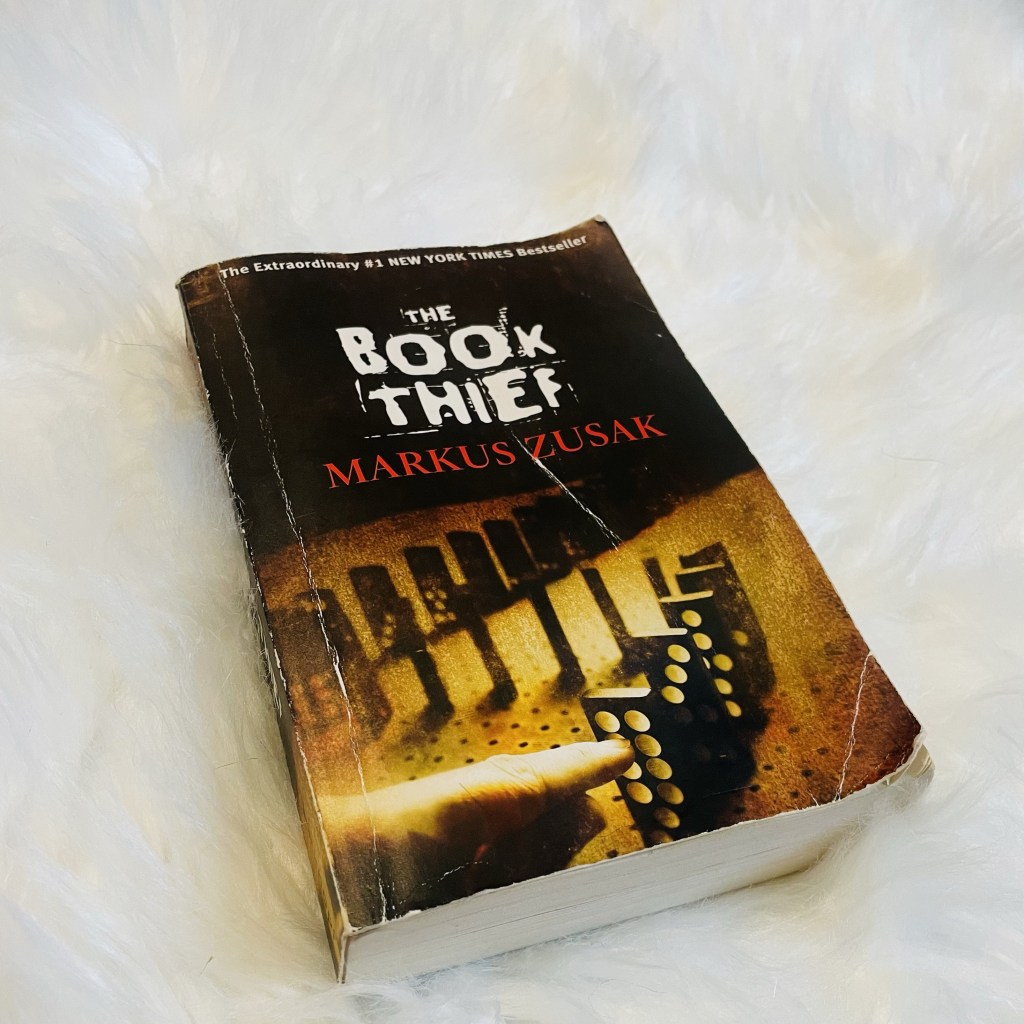
The Book Thief by Markus Zusak: A Five-Star Book Review
This post contains product affiliate links. I may receive a commission if you make a purchase after clicking on one of these links.
The Book Thief by Markus Zusak has been on my to-be-read shelf for a decade. It was one of those books that was a carryover from a disbanded book club that I promised myself I’d “get to soon.” Well, I finally read it this September as part of the Clear Your Shelf Challenge, and I am so glad I finished this masterful work.
Summary of The Book Thief (No Spoilers)
The Book Thief begins as Adolph Hitler is spreading his evil throughout Germany. Death, our narrator, can see the nightmare beginning, but is distracted by Liesel, a young, naive German girl on a train, when Death is summoned to take her brother from her arms. Intrigued by Liesel as she steals her first book at her brother’s graveside, Death follows her to her foster family’s home in a small town near Munich.
Under Death’s watchful eye over the years, Liesel learns the power of words, books, and kindness at the hands of her foster father as she struggles to make sense of her own childhood and teenage years in the midst of a war. Her life becomes even more complicated when her home becomes the hiding place for Max, the Jewish son of her foster father’s fellow World War I soldier. Max’s arrival is one of many pivotal moments for Liesel, and for Death as the narrator observes.
What I Enjoyed about The Book Thief
The Book Thief represents one of my favorite types of reading experiences because it broke my heart. Here’s why.
The Concept
Using Death as the narrator of a book is a bold move. Making Death a sympathetic narrator is even bolder. Liesel’s story would have been compelling enough on its own, in my opinion, but Death’s narration adds multiple layers to the book. First, Mr. Zusak challenges our concept of Death as the narrator wants to follow a living child throughout her days, rather than only meet a person in her final moments. Also, Death’s narrative gave great attention to the devastation and horrors of the Holocaust and World War II in a unique way that I hadn’t seen before.
The Characters
There are so many outstanding characters in The Book Thief in addition to Death. Liesel is an observer who grows into a bright, brave young woman. Her foster father, Hans, is a loving, gentle soul who I can picture playing the accordion and patiently teaching Liesel to read despite the terrors around them. Rosa, Liesel’s foster mother, is a brusque woman who appears cruel and one-dimensional at first but develops throughout the book. Max is riddled with fear and survivor’s guilt as he hides in the family’s home. His relationship with Liesel is brutally tentative and fragile. And finally, Rudy Steiner is a fiercely loyal, categorically perfect best friend as he remains steadfastly joined to Liesel’s side in her book robberies. All of these characters, as well as many side characters, are beautifully vivid in their actions and descriptions within The Book Thief, and I loved them.
The Writing
An author’s writing style is one of the first things I notice in a book, and The Book Thief is no exception. Mr. Zusak is expressive without being overblown; his writing is sharp and realistic. Also, he used his talents to structure this book in a unique way, giving previews to the story with unique chapter titles and even jumping ahead in the plot and then backtracking to tell us the entire story. I loved it all.
My Final Thoughts on The Book Thief
While Mr. Zusak’s book is fiction, he has shared that his parents’ experiences in World War II Germany have been major influences on his life and writing. The Book Thief makes a poignant statement about what Hitler’s evil did to so many. This book will stay with me, and I’m grateful to have read it.
One of my all-time favorite books is Night by Elie Wiesel, a brutal, historic portrait of Mr. Wiesel’s experiences during the Holocaust. When reading The Book Thief, I thought about Night a lot, and I think that both books should be required reading for all so that we can understand and remember.
 Bookish Brain
Leave a comment